

Materials
Choosing a material
Each material has strengths and limits. Here is what we stock right now and what each is best for.
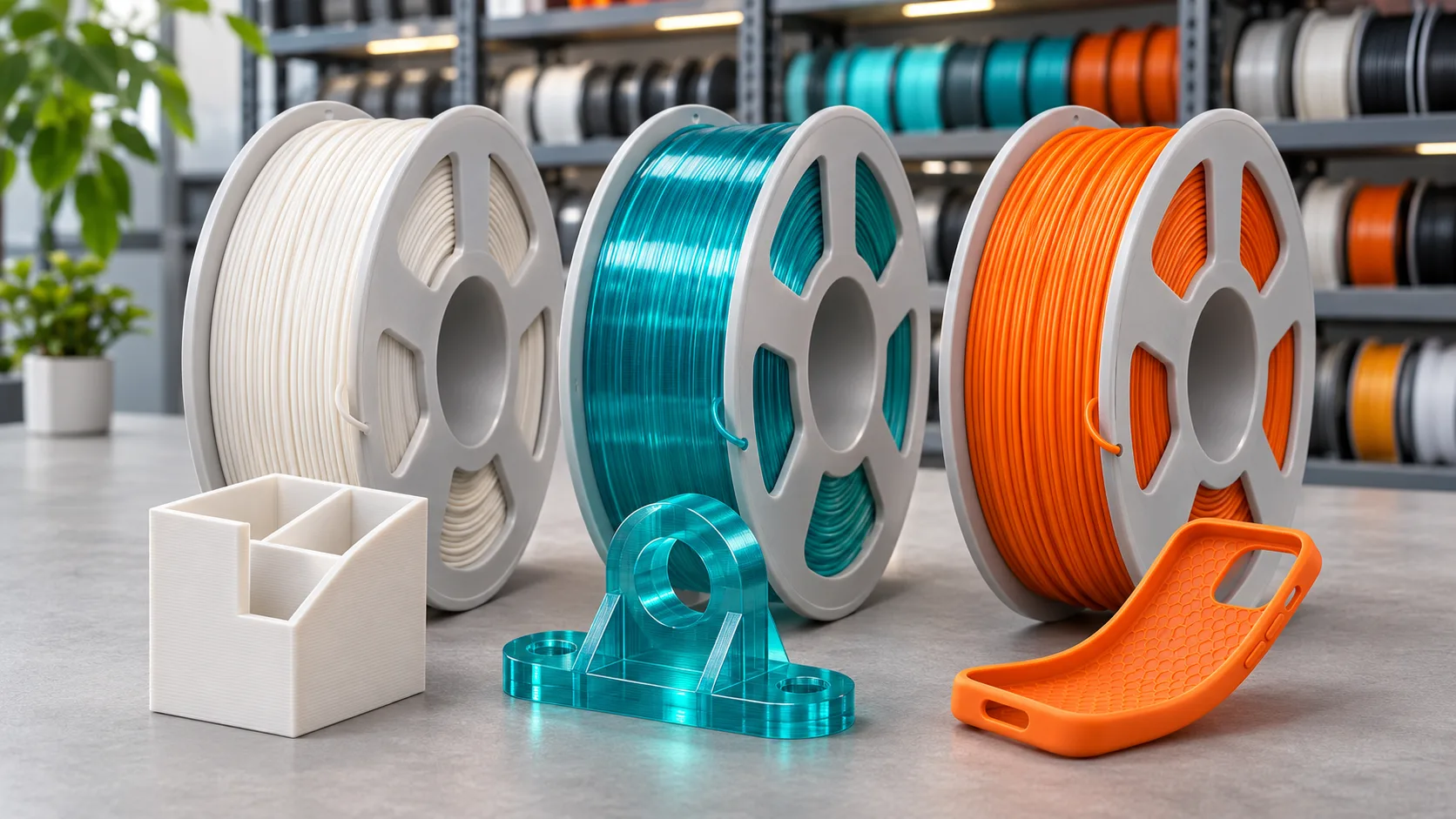
-
PLA - Standard
Economical and relatively rigid. Great for toys, decorations and many indoor parts.
Limitations
Rigid but fairly brittle: it can crack from drops or sharp knocks. Low heat resistance: can soften in a hot car or direct sun.
-
PETG - Durable
Tougher and less brittle than PLA with better heat resistance, though not always stronger under bending loads. Useful for clips, brackets and functional parts.
Limitations
Slightly glossy surface; very fine details are a little softer than PLA.
-
TPU - Flexible
Rubber-like and flexible (we print TPU 95A, a fairly firm rubber). Ideal for grips, bumpers, seals and phone cases, not for rigid load-bearing parts.
Limitations
Absorbs moisture from the air, so it needs dry storage. Slower to print, and offered only when the printer setup and stock support it.
-
ABS
A tough plastic for functional prototypes, housings and parts that need more heat resistance than standard PLA.
Limitations
Needs an enclosed, ventilated printer and can warp on large parts. Poor long-term UV resistance: not for parts left in the sun.
-
Nylon
Not available at the momentPolyamide with good wear resistance for durable functional parts such as gears, hinges and fittings.
Limitations
Absorbs moisture, which can affect dimensions and performance. Properties such as heat resistance vary a lot by nylon grade; we confirm the grade on your quotation.
-
PLA CF
Not available at the momentPLA blended with carbon fibres for rigid parts and a textured finish. Useful for display models and prototypes.
Limitations
Carbon fibres make it stiffer, not tougher: it is more brittle than plain PLA and has the same low heat resistance.
-
PETG CF
Not available at the momentPETG blended with carbon fibres for stiff functional prototypes, brackets and housings.
Limitations
Carbon fibres add stiffness, but layers bond no better than plain PETG, so parts are still weaker across layers. Not intended for repeated flexing.
-
ASA
Not available at the momentUV- and weather-resistant plastic with good heat resistance and toughness. Ideal for outdoor fixtures, automotive parts, equipment housings and functional components exposed to sunlight.
Limitations
Can warp on larger parts. Requires an enclosed printer, a heated bed and proper ventilation due to printing fumes.
-
Not sure which one?
Choose "Not sure — recommend for me" on the order form and tell us how the part will be used. We will pick a suitable material before we quote.
Compare materials
How each material behaves, rated from 1 (low) to 5 (high).
| Material | Strength | Stiffness | Impact resistance | Durability (wear) | Flexibility | Heat resistance | UV resistance | Absorbs moisture | Surface appearance | Printing difficulty | Strength goal | Suitable for |
|---|---|---|---|---|---|---|---|---|---|---|---|---|
| PLA - Standard |
|
Display models, figurines, toys, decorations, prototypes and indoor parts | ||||||||||
| PETG - Durable |
|
Functional parts, brackets, clips, containers and covered outdoor fixtures | ||||||||||
| TPU - Flexible |
|
Phone cases, grips, bumpers, seals, gaskets and feet | ||||||||||
| ABS |
|
Housings, enclosures and functional prototypes that get warm (not for long sun exposure) | ||||||||||
| Nylon Not available at the moment |
|
Gears, hinges, bushings, fittings and parts that wear | ||||||||||
| PLA CF Not available at the moment |
|
Stiff display models, prototypes, jigs and matte-finish parts | ||||||||||
| PETG CF Not available at the moment |
|
Brackets, mounts, jigs, fixtures and stiff housings | ||||||||||
| ASA Not available at the moment |
|
Outdoor brackets, automotive trim, garden fixtures, outdoor equipment enclosures and weather-resistant housings | ||||||||||
| Material | Strength | Stiffness | Impact resistance | Durability (wear) | Flexibility | Heat resistance | UV resistance | Absorbs moisture | Surface appearance | Printing difficulty | Strength goal | Suitable for |
What each column means
- Strength
- How much load a part carries before it breaks, for example a bracket holding weight.
- Stiffness
- How well it resists bending under load. Stiff is not the same as tough: a stiff part can still snap.
- Impact resistance
- How well it survives drops, knocks and sudden shocks without cracking (toughness).
- Durability (wear)
- Wear resistance: how well surfaces hold up to rubbing, sliding and repeated handling, such as gears, hinges and clips.
- Flexibility
- How much it bends or stretches without permanent damage. 5 is soft and rubber-like; 1 is rigid.
- Heat resistance
- How well it keeps its shape when warm, for example in a parked car. A comparison, not a safe operating temperature.
- UV resistance
- How well it holds up in sunlight over months without fading, turning brittle or cracking. Water is covered by Absorbs moisture.
- Absorbs moisture
- How much water it soaks up from the air. Higher means it needs dry storage, and parts can change size or strength slightly in humid places. Fewer bars are better
- Surface appearance
- How parts typically look straight off the printer: smooth or matte texture and how crisp fine details are. Matte blends such as carbon fibre hide layer lines but do not show finer detail.
- Printing difficulty
- How hard it is to print reliably on our own printers and settings: relative to the other materials here, not the same on every printer. Higher means harder: very fine details, large flat parts or tight tolerances may be limited. Fewer bars are better
Strength goal
The strength and flexibility goals this material suits. You choose one on the order form.
- Standard
- Suitable for most decorative and light-use parts.
- Rigid
- Stiffer parts that should not bend, such as stands and enclosures.
- Tough
- Parts that take knocks or load, such as brackets and clips.
- Flexible
- Bendable, rubber-like parts such as grips, bumpers and seals.
Strength goals are goals, not guarantees of mechanical performance. Tell us about loads, heat and fit in the instructions so we can choose the right material and settings.
More filled bars mean more of that property. For absorbing moisture and printing difficulty, fewer bars are better. Ratings compare these materials with each other for the grades we print (TPU is 95A; nylon properties vary by grade, and we confirm it on your quotation). They are guidance, not measured values: results depend on the part design, print orientation and settings.
Find a material for your use
Switch on the properties your part needs and set the level for each. The list updates as you go.
Matching materials
-
Not available at the moment
No material meets all of these. Lower a level or switch a property off.